
Simpsonville, SC · Garage Door Service
Emergency Garage Door Repair, Woodruff SC
Broken spring or stuck door in Woodruff? Simpsonville Garage Door Pros runs the 12-mile call and carries parts sized for this town's 1963-era housing stock.
- Repairs & new doors
- Springs & openers
- Serving 4 nearby communities
How Long You Are Without the Door
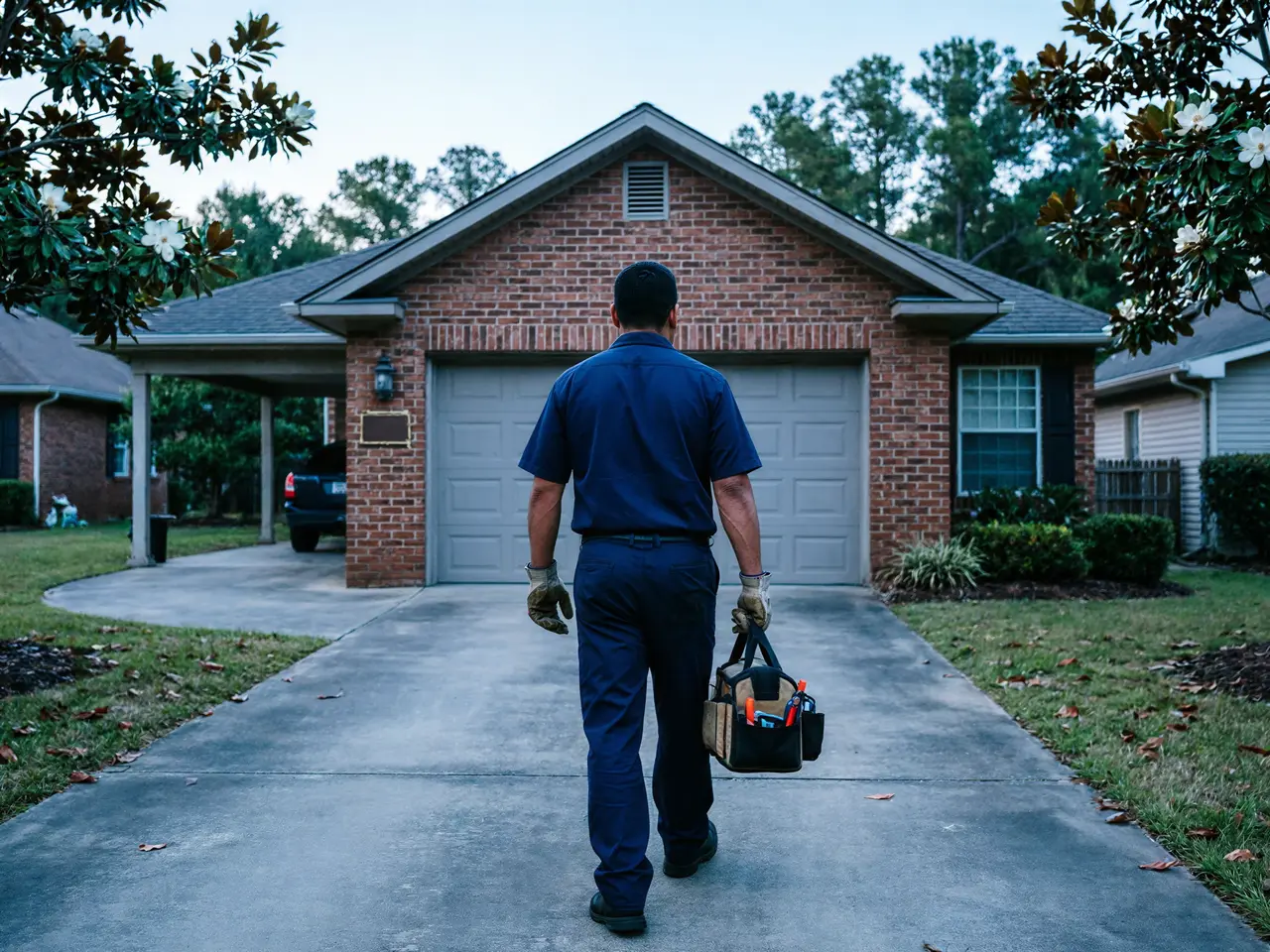
Woodruff sits 12 miles out from our shop in Simpsonville, and that drive is the first thing to understand about an emergency call here. We're not based in town, so when a spring lets go or a cable snaps off a drum, the truck is coming from Simpsonville, not around the corner. That distance shapes how we triage calls - we ask more on the phone up front (what the door is doing, whether it's a double or single, whether the opener still has power) so the right parts are on the truck before it leaves, instead of after a wasted first trip. A door that won't close is a security problem the moment it happens, and a door that won't open can trap a car inside, so we treat both as same-day priorities once we're rolling. The 12-mile run from Simpsonville means we plan the route, not the urgency - the job still gets handled as an emergency, it just starts with a phone call that does more work than it would for a closer address.
Why This Fails Locally
Woodruff's housing stock centers on 1963, which puts a meaningful share of the town's garage doors on original or first-replacement hardware from a different era than what you'll find closer in toward Simpsonville, where the broader service area's housing runs 1938 to 2013 with a median around 1979. A door installed in the 1960s, or even a 1980s replacement hung on 1960s framing, often carries a torsion spring sized for a lighter wood-panel door than the heavier steel or insulated doors sold today. When a homeowner swaps the door but not the spring and drums, the opener ends up doing work it was never geared for, and that's what burns out gears and strips sprockets early. Across the wider area there are 1,804 households in Woodruff, with median income around $64,292 - higher than the broader service area's $55,378 - and what we see on calls out here tends toward owners who've kept the original door longer and upgraded the opener once, rather than replacing both together. That mismatch between old spring hardware and a newer opener is a specific, repeatable failure, not a general garage-door complaint.
The Symptom
The call we get most from this side of the service area starts the same way: the opener runs, the motor hums, and the door doesn't move, or it moves a few inches and reverses. That's almost always a spring that's lost tension - not a motor problem, even though the motor is what the homeowner hears working hardest. On a door this age, the spring itself may be original or a prior repair spring that doesn't match the door's current weight, especially if an insulated replacement door went on without upgrading the spring rate. A second common symptom is a door that slams the last foot of travel instead of settling - that's a spring too weak for the door, straining the opener's drive gear every time it closes. Neither of these is safe to keep running through; a spring under the wrong tension can snap, and the cable attached to it can whip loose. If your door is doing either of these, stop running the opener on it and call before the gear strips.
The DIY Question
Torsion springs store enough force to break bones, and the wound-up ones on a door this age have had 60 years for the steel to fatigue unevenly, which makes them less predictable than a new spring would be. We don't recommend attempting a spring swap yourself, full stop - not because the mechanics are secret, but because the margin for error with winding bars and an unknown spring age is too thin. Where DIY is reasonable: tightening visible hardware, lubricating hinges and rollers, and testing the auto-reverse safety feature by placing a block under the door and running it down. Those take ten minutes and don't involve stored tension. One honest limitation - if the door is original to a 1960s build and the track or jambs have shifted with the house over time, a spring swap alone won't fix a door that's also binding on crooked track, and we'll tell you that on site rather than charge you twice for two separate fixes.
Parts We Carry
Because Woodruff's stock skews older, the truck for a Woodruff call carries a wider spread of torsion spring sizes than a call closer to newer construction would need, including rates sized for older lighter-panel doors as well as current steel and insulated doors. We stock standard rollers, cables, and drums that fit the sectional doors common across the service area's 1960s-70s housing, along with the openers and safety sensors that get retrofitted onto older setups. What we don't carry on the truck: obsolete wood panel sections or discontinued hardware specific to a single original manufacturer - if a door needs an exact panel match to a 1960s model no longer produced, that's a special-order part, and we'll say so rather than promise a same-visit fix we can't deliver.
What Can Go Wrong
On a door built or last serviced around 1963, the failure points cluster in a few places: the torsion spring reaching end of life after decades of cycles, the cable fraying where it wraps the drum, and the track brackets loosening from the jamb as the house has settled. A less obvious one - openers added decades after the original door was hung are sometimes mounted to framing that was never meant to carry that load, and over time the mounting bracket itself pulls loose rather than the opener failing. We also see rollers that were never upgraded from steel to nylon, which get louder and rougher year over year until the door binds in the track. None of these are rare on a door this age; they're the ordinary wear pattern for 1960s stock, and catching the spring or cable before it fails outright is cheaper and safer than an emergency call after it does.
Frequently asked questions
How far out is Woodruff from your shop, and does that affect how fast you can come?
Woodruff is about 12 miles from our Simpsonville location. We don't keep a branch in Woodruff, so every call is a dispatched trip, and we ask detailed questions on the phone so the truck arrives with the right spring size and parts rather than needing a second trip.
Why does my 1960s garage door need a different spring than a newer one?
Older doors in Woodruff were often built lighter than today's insulated steel doors. If a homeowner replaced the door over the years without upgrading the spring, the spring is now under-sized for the door's actual weight, which causes slamming, reversing, or early failure.
Can I replace a torsion spring myself to save time before you arrive?
We'd rather you didn't. A wound torsion spring holds enough force to cause serious injury, and on an older door the spring's exact age and wear are hard to judge without tools. Lubricating rollers and testing the auto-reverse safety feature are safe DIY steps in the meantime.
Do you carry parts for older doors on the truck, or do you have to order them?
We stock a wide range of torsion spring sizes, standard rollers, cables, and drums that cover most 1960s-70s doors in the area. Discontinued wood panels or manufacturer-specific hardware from the original install sometimes have to be special-ordered.
Book garage door service in Simpsonville
Call now or request a quote - tell us what the door is doing and where you are.