
Simpsonville, SC · Garage Door Service
Off-Track Garage Door Repair for Woodruff Homes
Woodruff's housing dates mostly to the early 1960s, and that older track hardware comes off its rail in ways newer doors don't. Here's what we see and carry on the drive out from Simpsonville.
- Repairs & new doors
- Springs & openers
- Serving 4 nearby communities
How Long You Are Without the Door
Woodruff is a small town - about 1,804 households, not a sprawling subdivision grid - and we don't keep a truck parked on this side of the county. Every off-track call here means a twelve-mile drive from our Simpsonville shop, so we plan the route and the parts before we leave rather than guessing once we're on site. That matters more in a town this size because an off-track door isn't a common call here the way it might be in a denser suburb closer to us; when we do get one, it's usually a hardware problem specific to the age of the house, not a random fluke. We'd rather show up with the right roller and track section than make a second trip. If you've already tried to force the door shut or up, tell us that on the phone - it changes what we bring, and sometimes it changes whether the fix is a track repair at all or something further back in the system, like a bent hinge or a pulled cable.
Why This Fails Locally
The typical Woodruff house dates to around 1963. At that age, track brackets are often lag-bolted directly into the framing rather than set on the engineered jamb mounts that came later, and the track gauge itself tends to be the older, narrower profile. Combine that with a cold-moderate climate where the garage swings through a real temperature range across the year, and the metal expands and contracts enough over decades to walk a bracket loose a sixteenth of an inch at a time. That's not a defect - it's just what fifty-plus-year-old steel does. A door that's never been serviced on a house this old is a door where at least one bracket is already past its original torque. Once a bracket shifts, the roller has a little more room to wander, and one hard gust or an opener that forces the door through a bind is enough to pull it clean off the rail. None of this shows up until the day it does.
The Symptom
Most off-track calls in a town like this start the same way: the door looks crooked in the opening, hangs low on one side, or stops partway with a grinding sound instead of a smooth close. Sometimes a roller has popped out of the track entirely and is visible hanging loose along the edge of the panel. Other times the door still looks straight but won't move at all - the opener strains, clicks, or reverses - because a roller has jumped the rail just enough to jam the whole assembly without ever leaving it visibly. If the door moved fine yesterday and is fighting you today, the fault is almost always mechanical, not electrical. Don't keep hitting the remote. Each extra cycle with a roller off its rail puts more stress on the track, the bracket, and sometimes the panel itself, turning a bracket adjustment into a track replacement.
The DIY Question
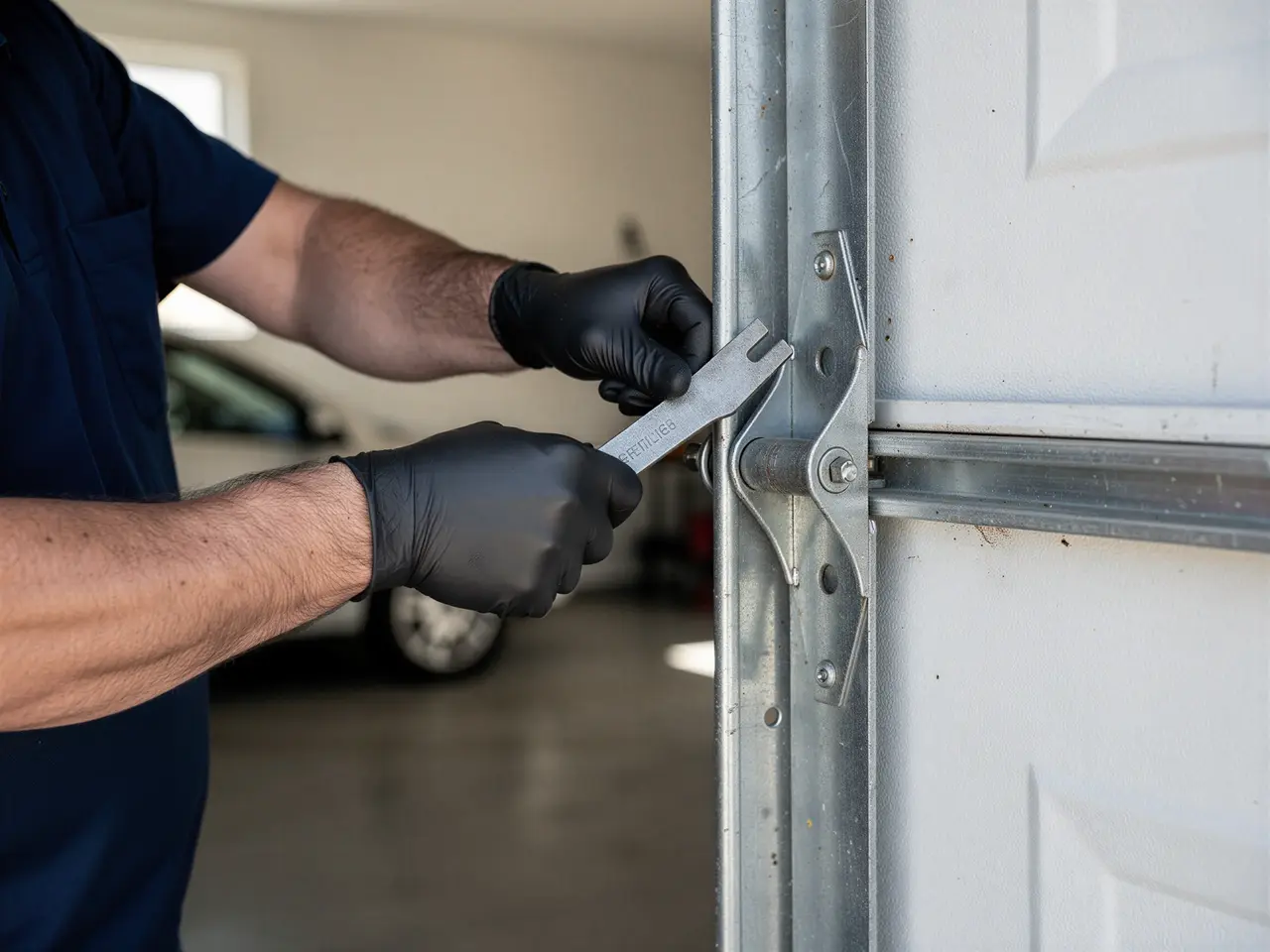
We'll say it plainly: don't try to force a door back onto its track yourself. A door off-track is usually still under spring tension, and a torsion or extension spring under load can do real damage if it lets go while you're working near it. If the door is partway open, leave it there and block it from closing further rather than trying to lower it the rest of the way. What you can safely do is kill power to the opener so it doesn't try to cycle again, and take a look - without touching the track - at whether a roller is visibly out or a cable looks slack. That tells us a lot before we even arrive. The honest limit here: if the track is bent rather than just knocked loose, bending it back rarely holds for long on a house this age, and we'll usually tell you a short replacement section is the better money than repeated adjustments.
Parts We Carry
Because a lot of Woodruff's garage stock sits in that early-1960s to 1970s window, we carry the older track and roller sizes that newer trucks sometimes don't bother stocking anymore - narrower gauge track sections, standard-stem rollers, and the flat brackets that match lag-bolted jamb framing rather than the newer engineered mount. We also carry nylon rollers as an upgrade from the steel ones often found in these older systems, since nylon runs quieter and doesn't wear the track the same way over time. For households weighing a full hardware refresh against a point repair, Woodruff's median income sits a bit higher than some nearby towns, which is part of why we don't default to a full tear-out - we'll tell you honestly when a bracket and roller swap solves it versus when the track itself needs replacing.
What Can Go Wrong
The most common failure we see on houses this age is a bracket that's walked loose enough to let the track splay slightly, which lets a roller ride up and over the edge under normal use. Less often, a hinge pulls partway out of an older, thinner panel, tilting the roller's angle of entry into the track until it jumps. On doors that have been forced while off-track, we sometimes find a cable that's frayed or come off its drum, which is a separate repair from the track itself and needs its own attention before the door's safe to cycle again. We won't put a door back into regular use with a compromised cable, even if the track repair is already done - that's the one shortcut we don't take.
Frequently asked questions
Why does my garage door keep coming off the track in Woodruff but my neighbor in a newer house never has this problem?
It usually comes down to the age of the hardware. Houses built around 1963, which covers a lot of Woodruff, often have track brackets lag-bolted into the framing rather than set on newer engineered mounts. Over decades of temperature swings, those brackets loosen slightly, giving the roller more room to wander off the rail.
Do you have a branch in Woodruff?
No. We run out of Simpsonville, about twelve miles away, and travel out for calls in Woodruff. We bring the parts we expect to need based on what you describe on the phone, including the older track and roller sizes common in this area's housing stock.
Can I just push the door back onto the track myself?
We'd rather you didn't. A door off-track is often still under spring tension, and forcing it can snap a cable or let a spring release suddenly. Cut power to the opener, leave the door where it is, and call - a visual check from you over the phone tells us a lot before we arrive.
Is it ever better to replace the track instead of repairing it?
Yes, especially on houses from the early 1960s where the track has been bent rather than just knocked loose. Bending it back rarely holds for long on hardware this age, and a short replacement section usually costs less in the long run than repeated adjustment calls.
Book garage door service in Simpsonville
Call now or request a quote - tell us what the door is doing and where you are.